Watch Tower Insights · Deep dive
The Retiring Crew: Construction's Worker Gap, and Who Fills It
- U.S. construction needs about 349,000 more workers in 2026, and most of that need comes from people retiring, not from new work.
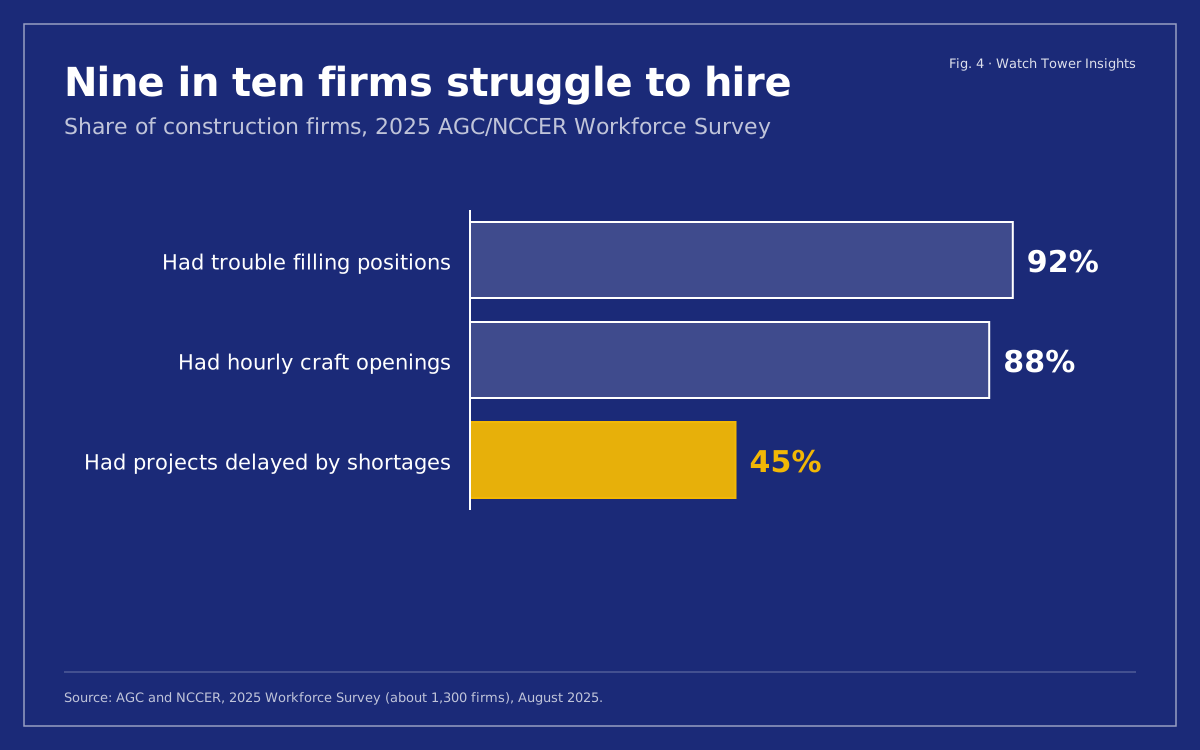
- Nine in ten contractors struggle to hire, and almost half have had projects delayed by it.
- The fastest gain for a crew and its contractor is keeping the know-how of the people about to leave. Here is the arithmetic, with every assumption shown.
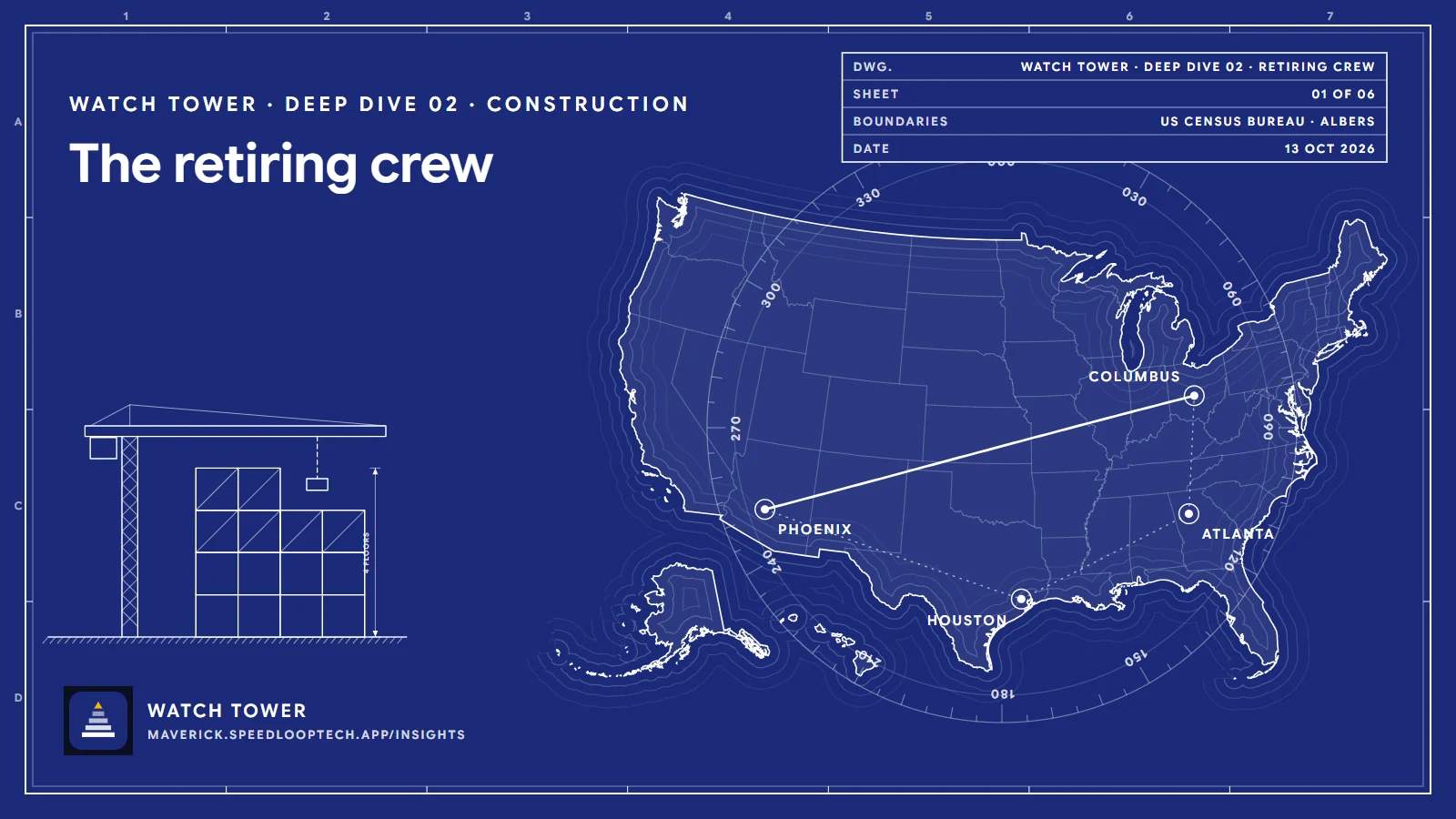
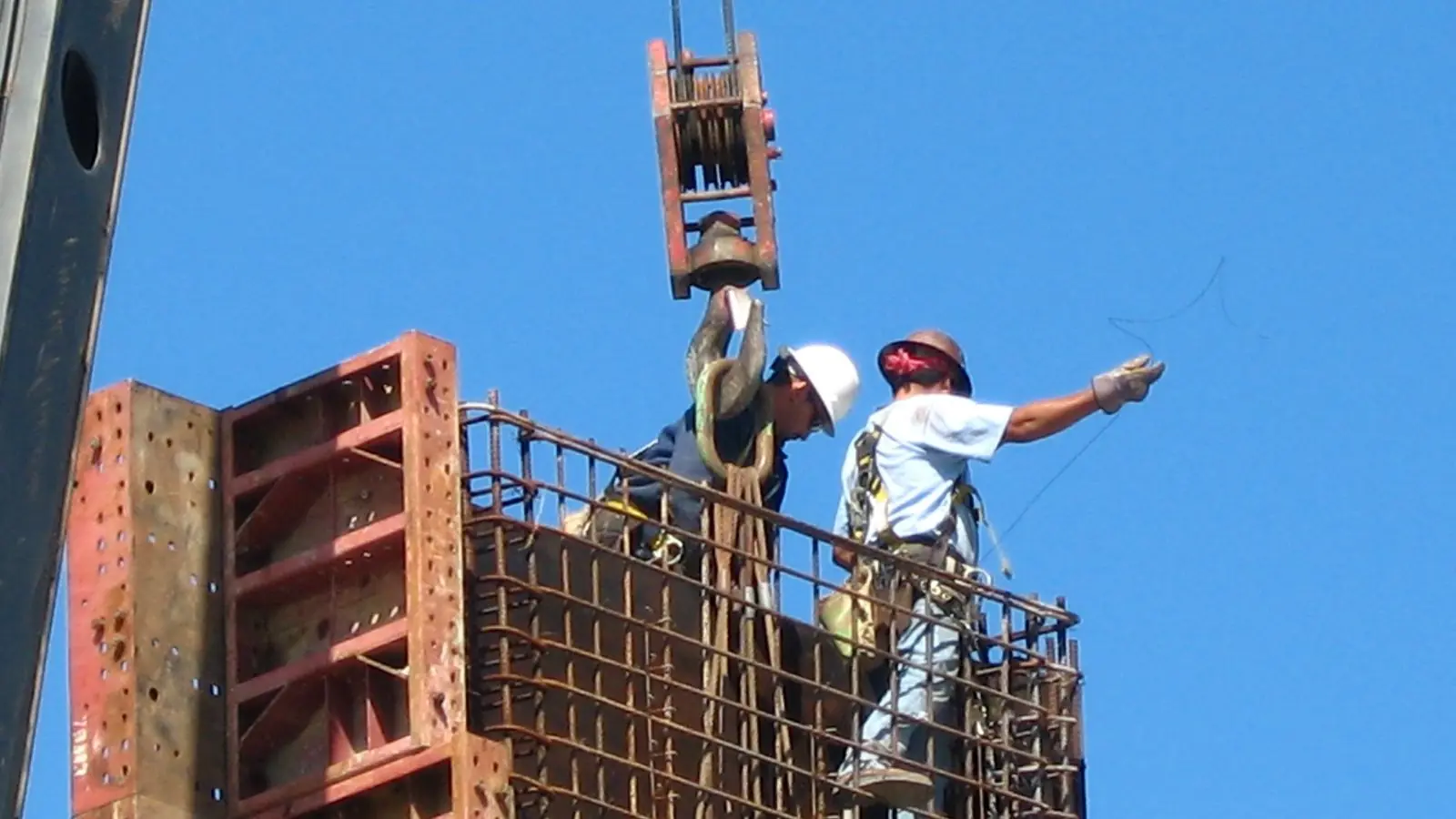
On most job sites there is someone everyone goes to. The superintendent who can read a set of drawings and see the clash before it is poured. The foreman who knows which crane setup works on a tight lot. The electrician who has wired the same kind of building forty times. Ask the crew how a hard day got solved, and the answer is often a name.
A growing share of those names are close to retirement. Associated Builders and Contractors (ABC), an industry association, estimates that U.S. construction must attract about 349,000 net new workers in 2026 just to keep up with demand, and says most of that need comes from replacing retirees rather than from new work.1
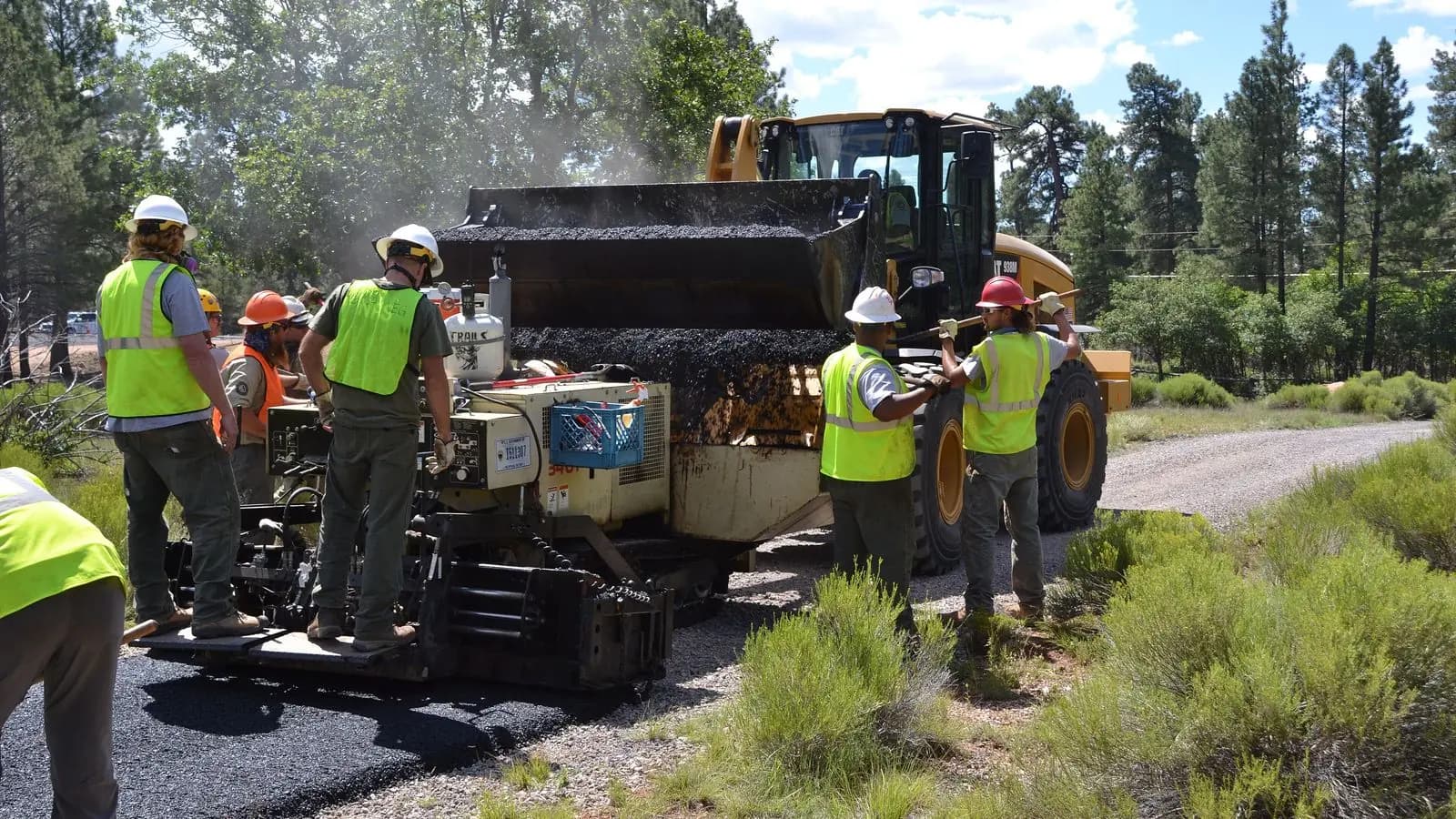
This deep dive looks at the size of that gap, what it means for the people on site and for the contractors who employ them, and the practical work that keeps a crew's know-how when its most experienced members leave. Every number has a source in the list at the end. Where we do arithmetic of our own, the assumptions are written next to it.
.jpg)
How many workers the industry needs
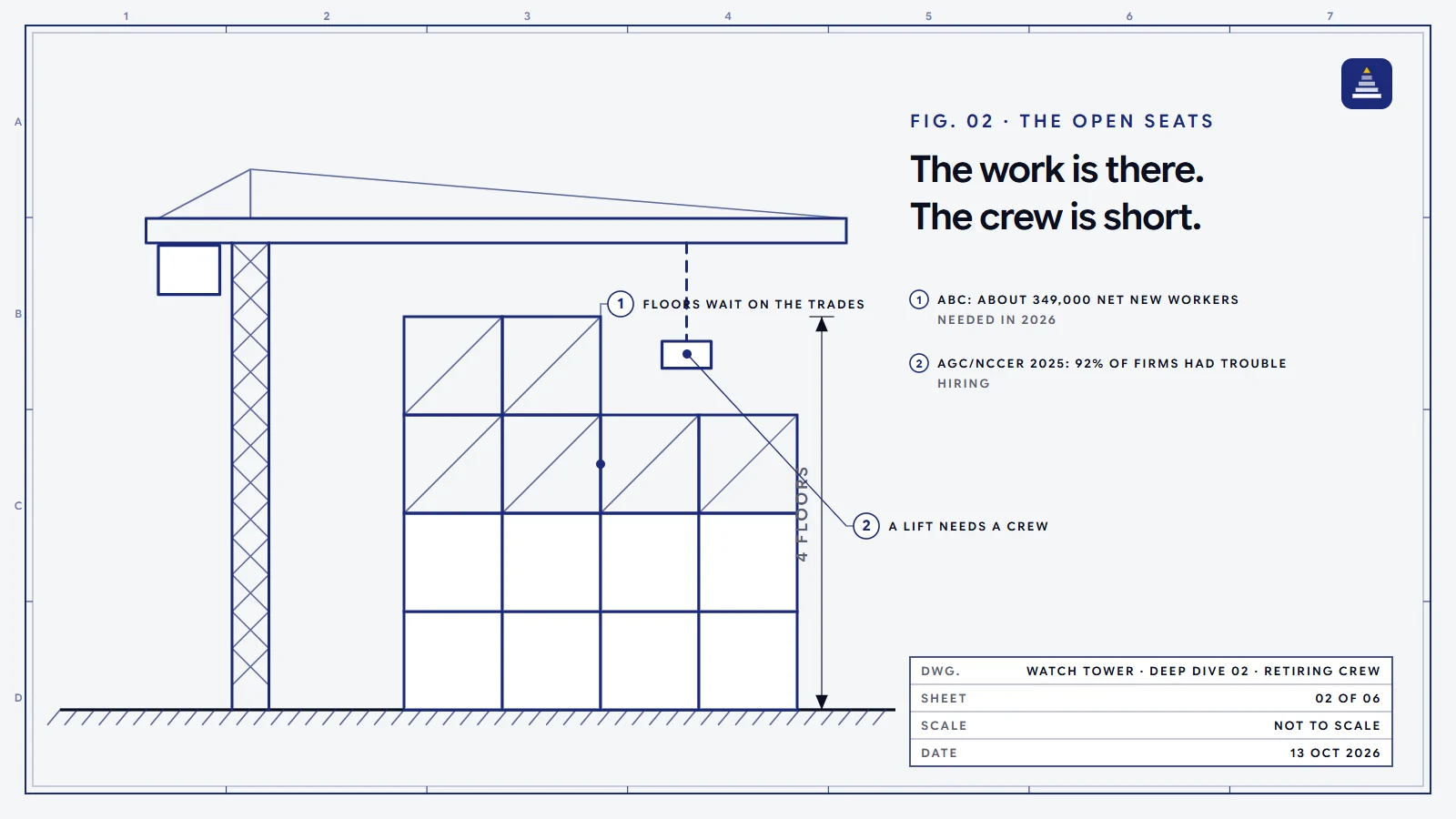
ABC's model turns expected construction spending into the number of workers needed to build it, about 3,450 jobs for every additional billion dollars, then adds job openings, unemployment in the industry and expected retirements.1 The result changes with the economy. The estimate was 439,000 for 2025, is 349,000 for 2026, and rises to 456,000 for 2027 as spending growth is expected to pick up.12
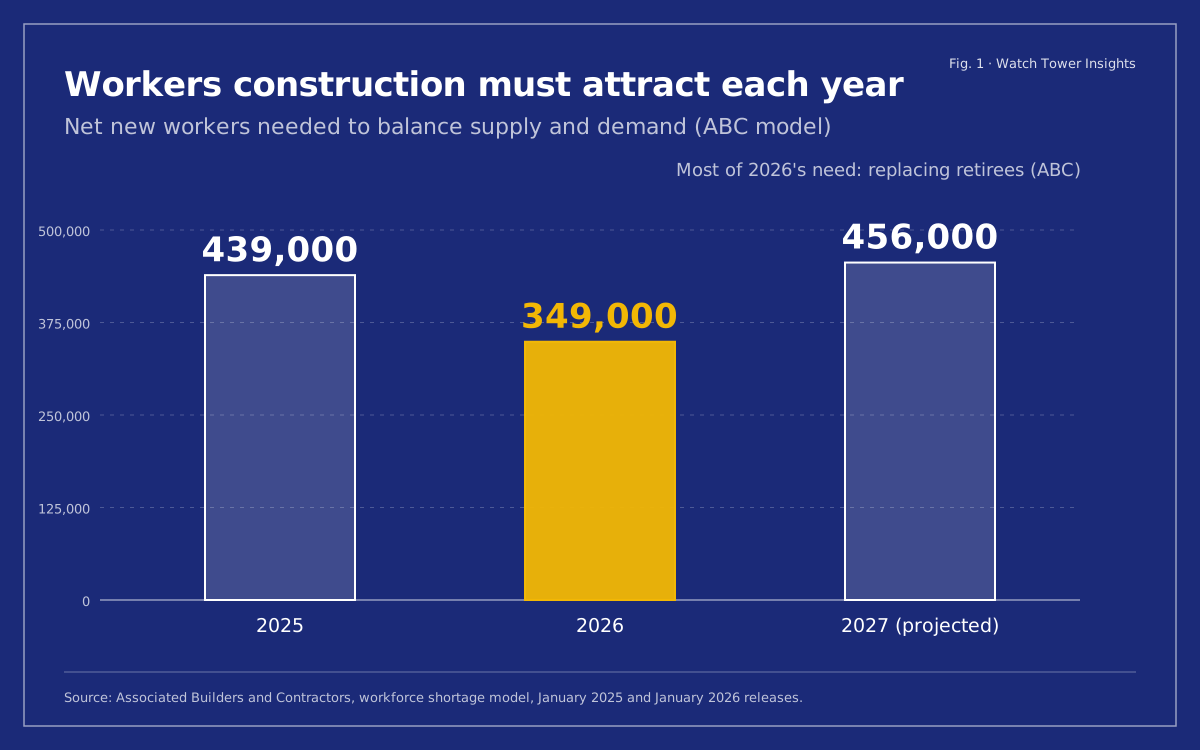
The spending side has cooled, which is why 2026's number is lower. The Census Bureau puts total U.S. construction spending at $2,164.4 billion in 2025, 1.4 percent below 2024, with public construction up 3.6 percent to $516.8 billion while private building slowed.11 Even in a flat year, the work does not shrink enough to cover the people leaving.
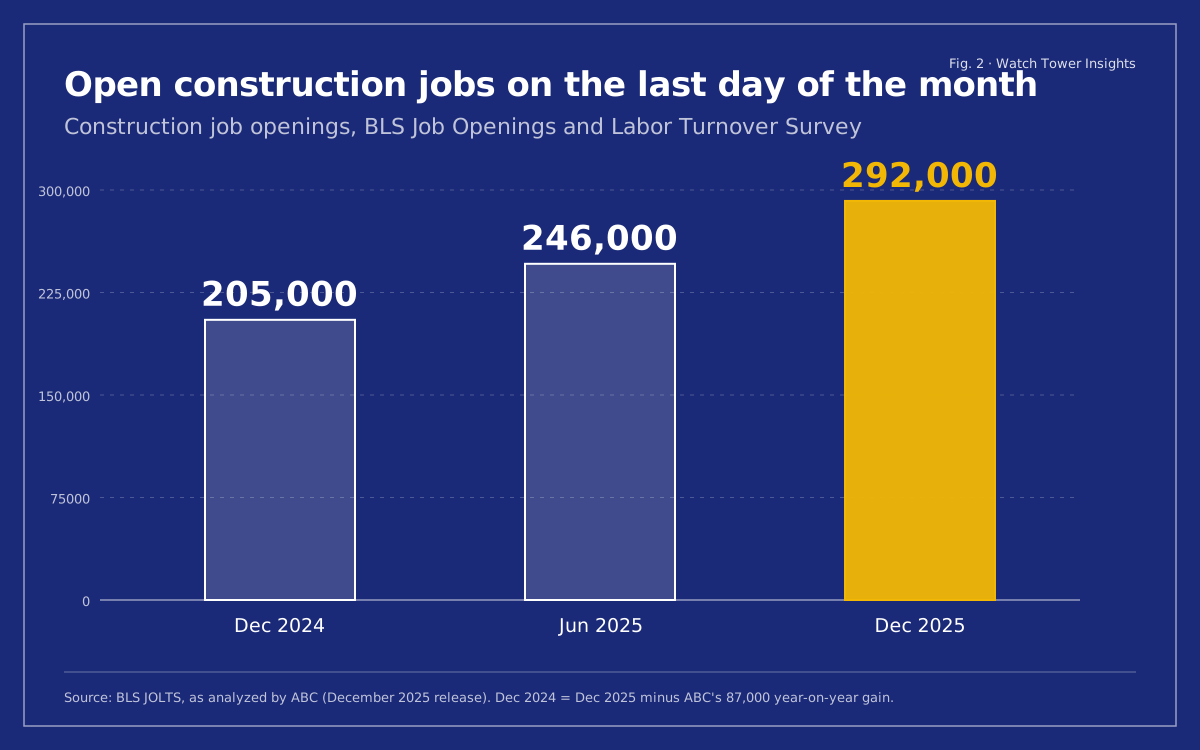
Open jobs tell the same story. At the end of December 2025, construction had 292,000 job openings, 87,000 more than a year earlier, according to ABC's analysis of the Bureau of Labor Statistics Job Openings and Labor Turnover Survey.5

Who is retiring
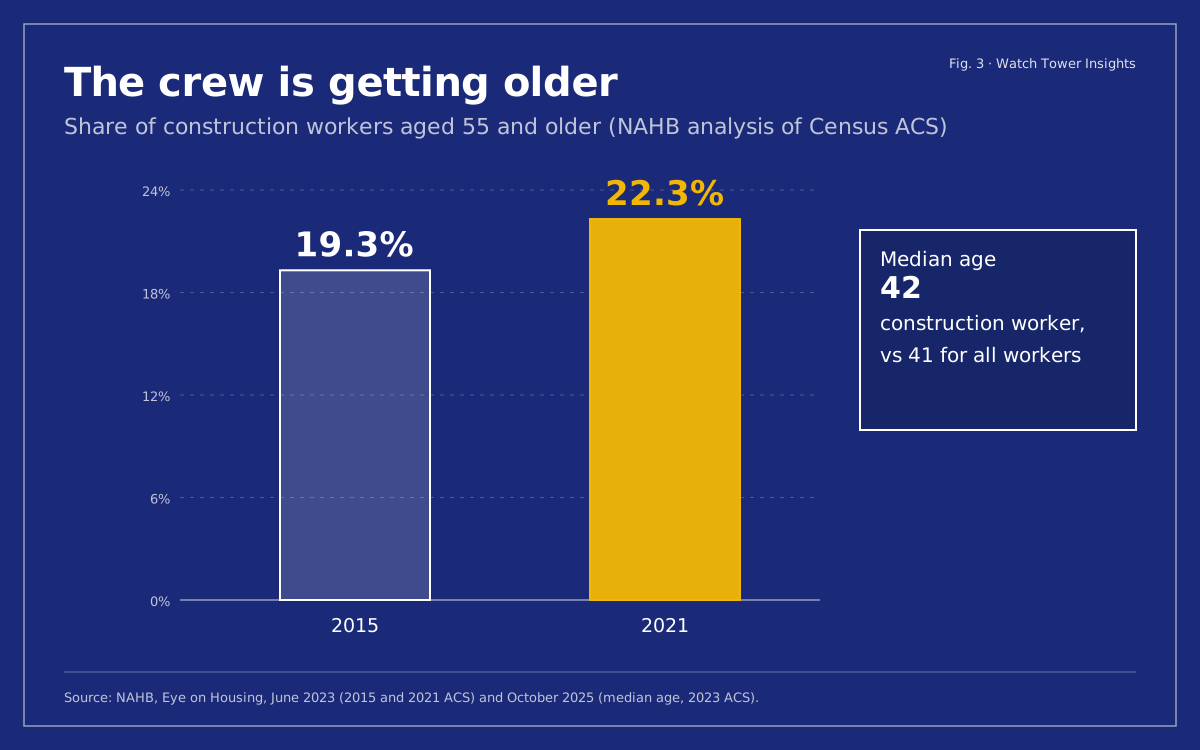
The National Association of Home Builders (NAHB), working from Census Bureau survey data, found that workers aged 55 and older rose from 19.3 percent of the construction workforce in 2015 to 22.3 percent in 2021, while the share aged 25 to 54 fell from 71.9 percent to 67.7 percent.6 The median construction worker is 42, a year older than the typical U.S. worker.7
Some trades feel it more. ABC notes that about one in five U.S. electricians is over 55, at the same time as data center construction is raising demand for exactly that skill.1 An age figure is not a retirement date, and many tradespeople work well past 60. But it shows where the experience sits, and how much of it will change hands over the next decade.

What a short crew does to a project
The 2025 Workforce Survey by the Associated General Contractors of America (AGC) and NCCER, a construction training foundation, asked about 1,300 contractors how hiring was going. 92 percent had trouble filling open positions, 88 percent had openings for hourly craft workers, and 45 percent said worker shortages had delayed projects, the leading cause of delays the survey found.34
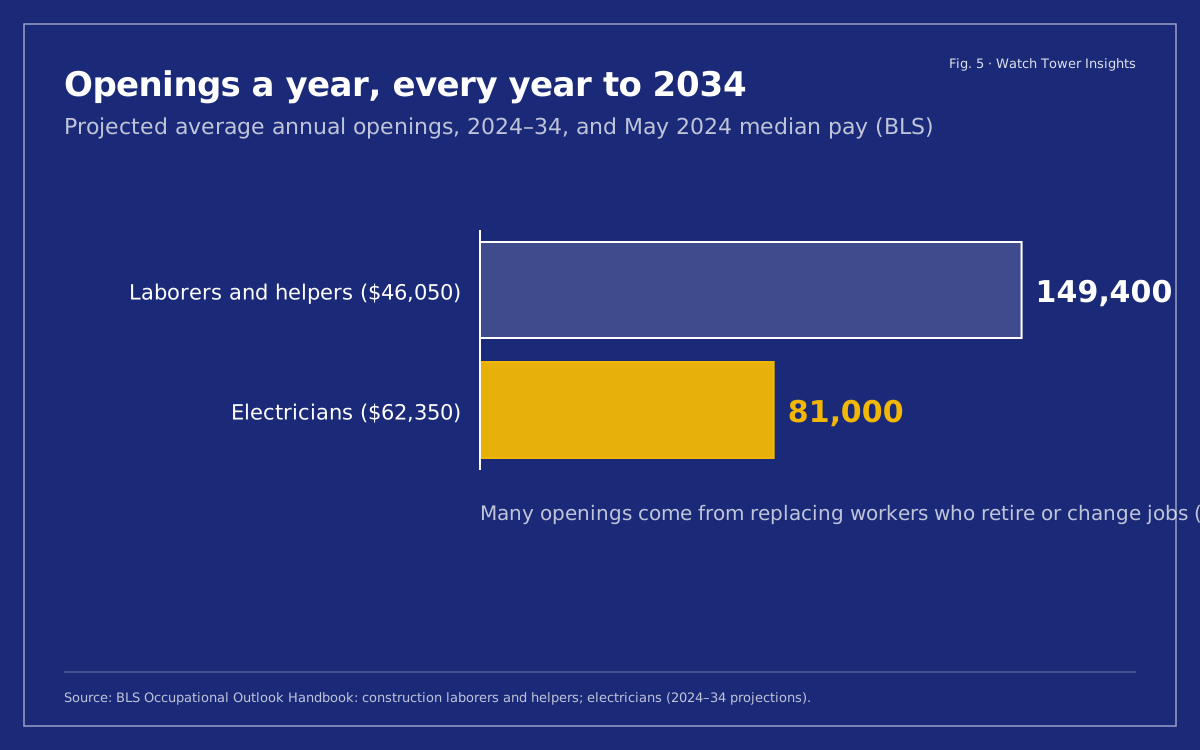
The pipeline is growing, but it starts small and takes years. The Department of Labor counts 480,399 apprentices served in construction in 2025, up 28 percent over five years.12 An apprentice electrician typically trains for four or five years before working on their own, and the Bureau of Labor Statistics projects about 81,000 openings for electricians and 149,400 for construction laborers and helpers every year to 2034, many of them to replace workers who retire or change careers.910
Why hiring alone can't close it
The arithmetic of training is the hard part. A worker who retires this year took a decade or more to become the person everyone asks. The person hired to replace them starts at the beginning. The Bureau of Labor Statistics notes that most electricians learn through an apprenticeship that typically lasts four or five years,10 and laborers and helpers learn on the job, under the eye of experienced workers.9
So the gap is not only a count of heads. It is a gap in experience, and it grows each year the departures outpace the training. That is why the same survey that found 92 percent of firms struggling to hire also found nearly half running late:3 a crew can be fully staffed on paper and still short of the judgment a hard job needs.
It also explains why the answer is not just to pay more. Higher wages help a firm win a worker from a competitor, and construction pay has been rising,13 but across the industry that moves people around rather than adding experience. The lasting gains come from shortening the time it takes a new hire to become safe and productive, and from keeping what the experienced crew knows when they leave.
There is a second, quieter cost. When only one or two people on a crew can do a task, every schedule bends around them. Their vacation, their sick day or their retirement party becomes a scheduling problem. Spreading that skill across more of the crew is as much about resilience as it is about growth.
What it looks like for one contractor
National numbers are hard to feel. Here is the same pattern at the size of one company. We assume a contractor with 30 people in the field, a round number for a small commercial or civil firm, and apply the industry-wide share of workers aged 55 and older. Replace both with your own crew list.
The retiring crew for one contractor, worked through
| People in the field (assumption: replace with yours) | 30 |
|---|---|
| Share of construction workers aged 55+ (NAHB, 2021)6 | 22.3% |
| Workers aged 55 or older: 30 × 22.3% | 6.7, about 7 |
| Years over which they might retire (assumption) | 10 |
| Experienced workers leaving each year: 7 ÷ 10 | about 1 |
Your crew's age mix will differ from the industry average, and retirement ages vary widely. The point is the order of magnitude: in a typical small firm, roughly one of the most experienced people leaves every year.
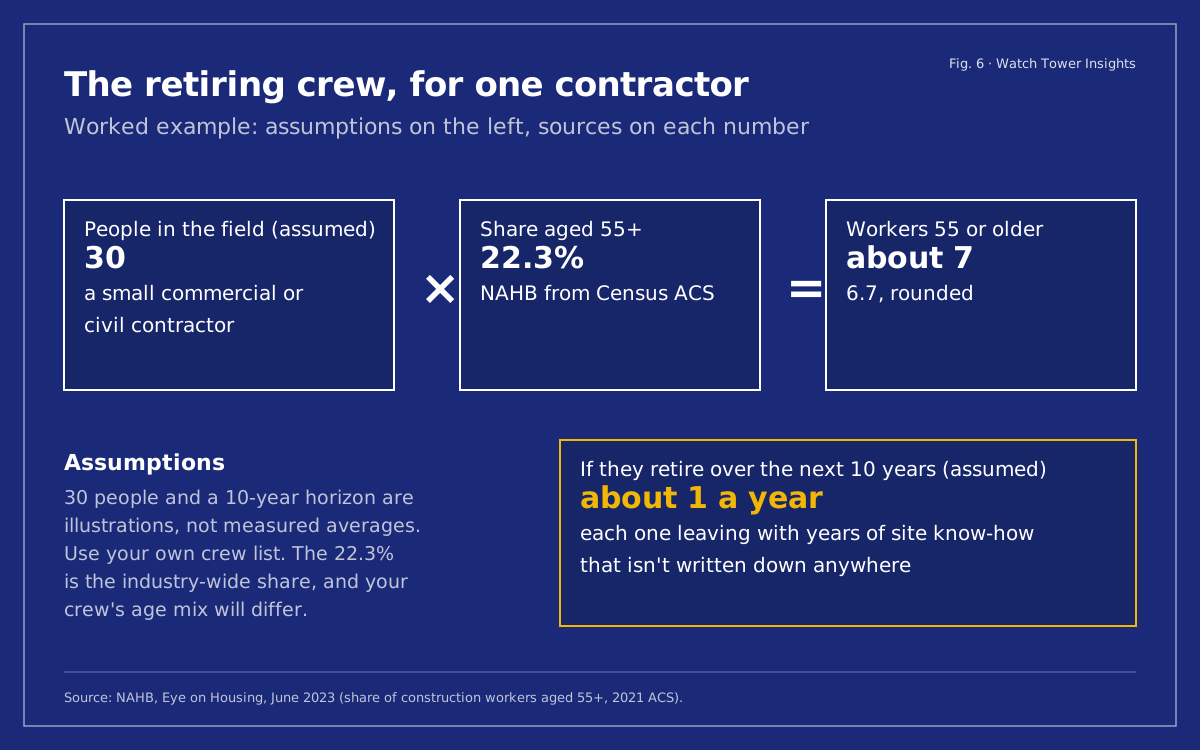
One person a year does not sound like much until you ask what leaves with them. It is rarely written down: which supplier delivers on time, how a particular inspector likes the paperwork, the sequence that keeps a pour from going wrong in cold weather, the shortcuts that are safe and the ones that are not. Each departure takes a piece of the firm's working memory.


What this means for the people
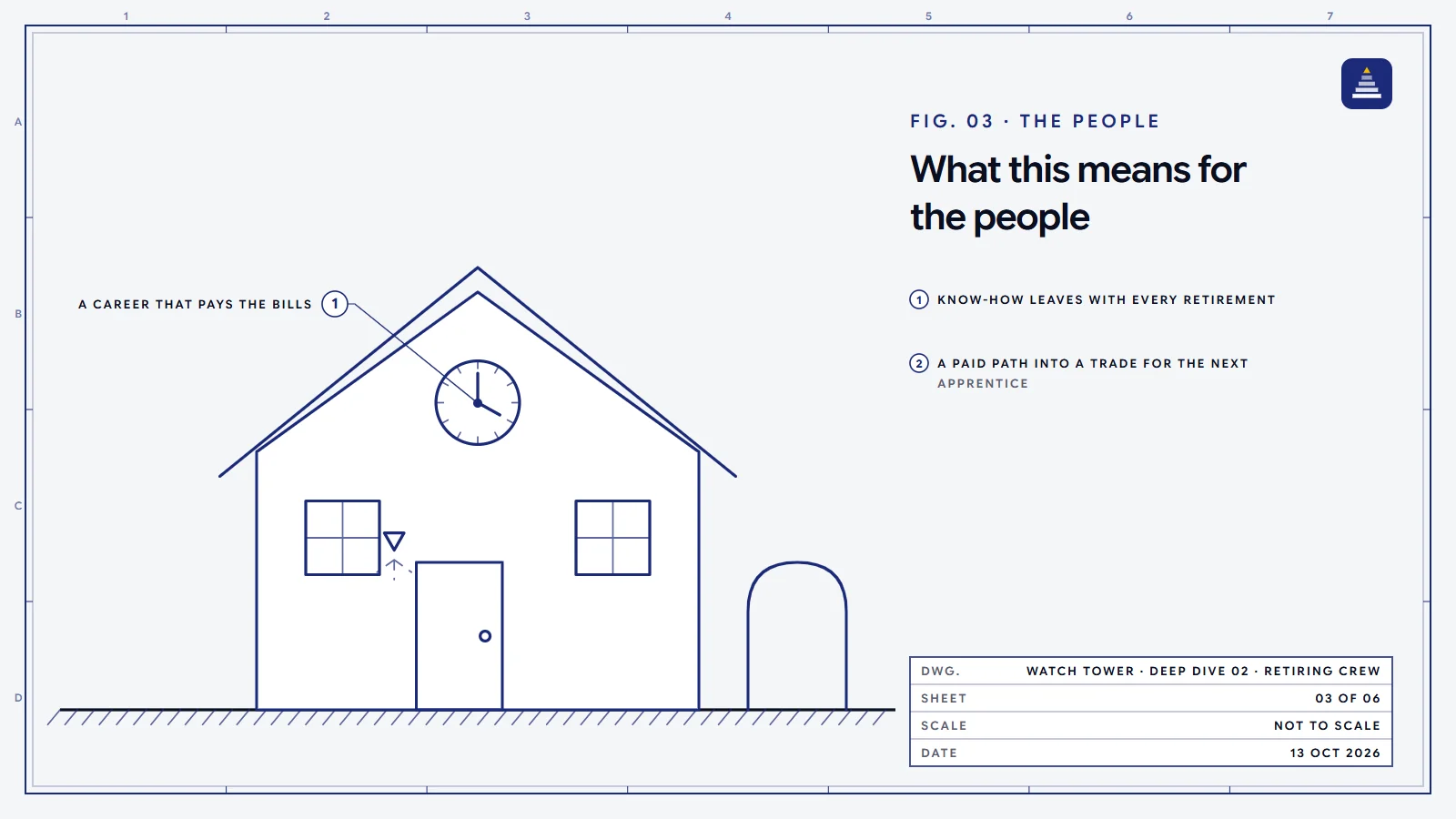
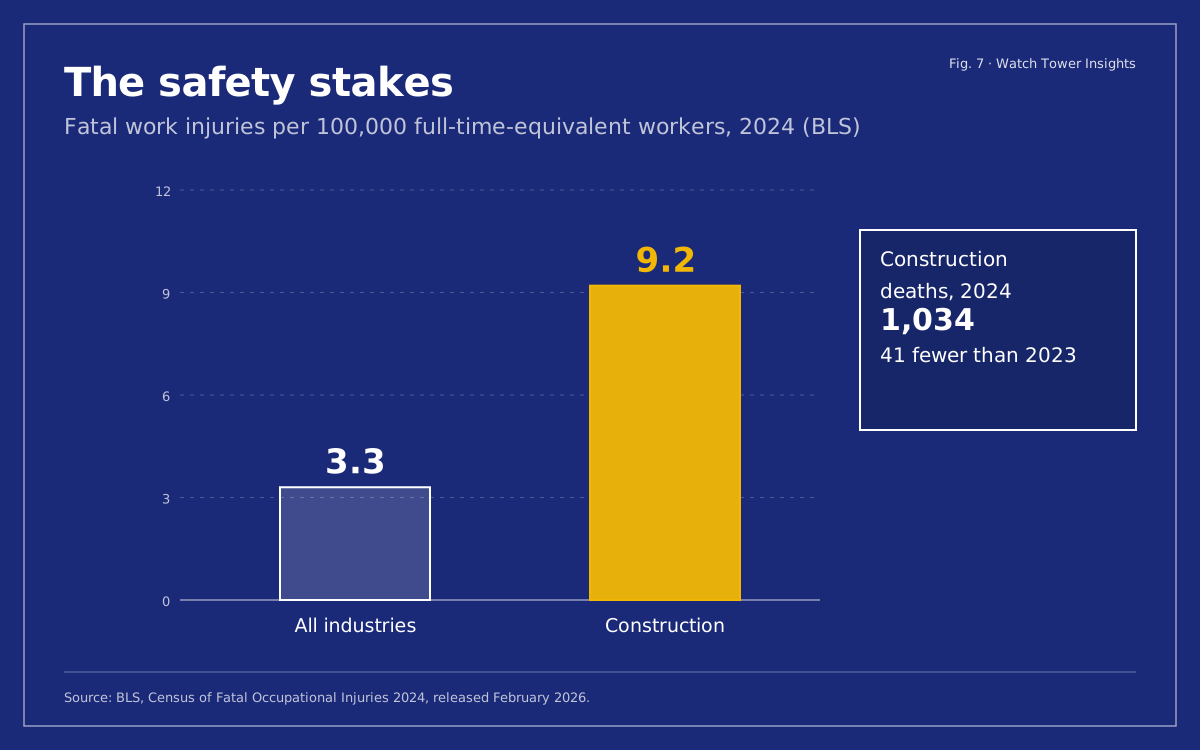
For the crew that stays, a short-handed site means longer days and more to watch. It also raises the stakes on safety. In 2024, 1,034 construction workers died on the job, 41 fewer than the year before. The industry's fatal injury rate was 9.2 per 100,000 full-time-equivalent workers, against 3.3 across all industries, according to the Bureau of Labor Statistics.814
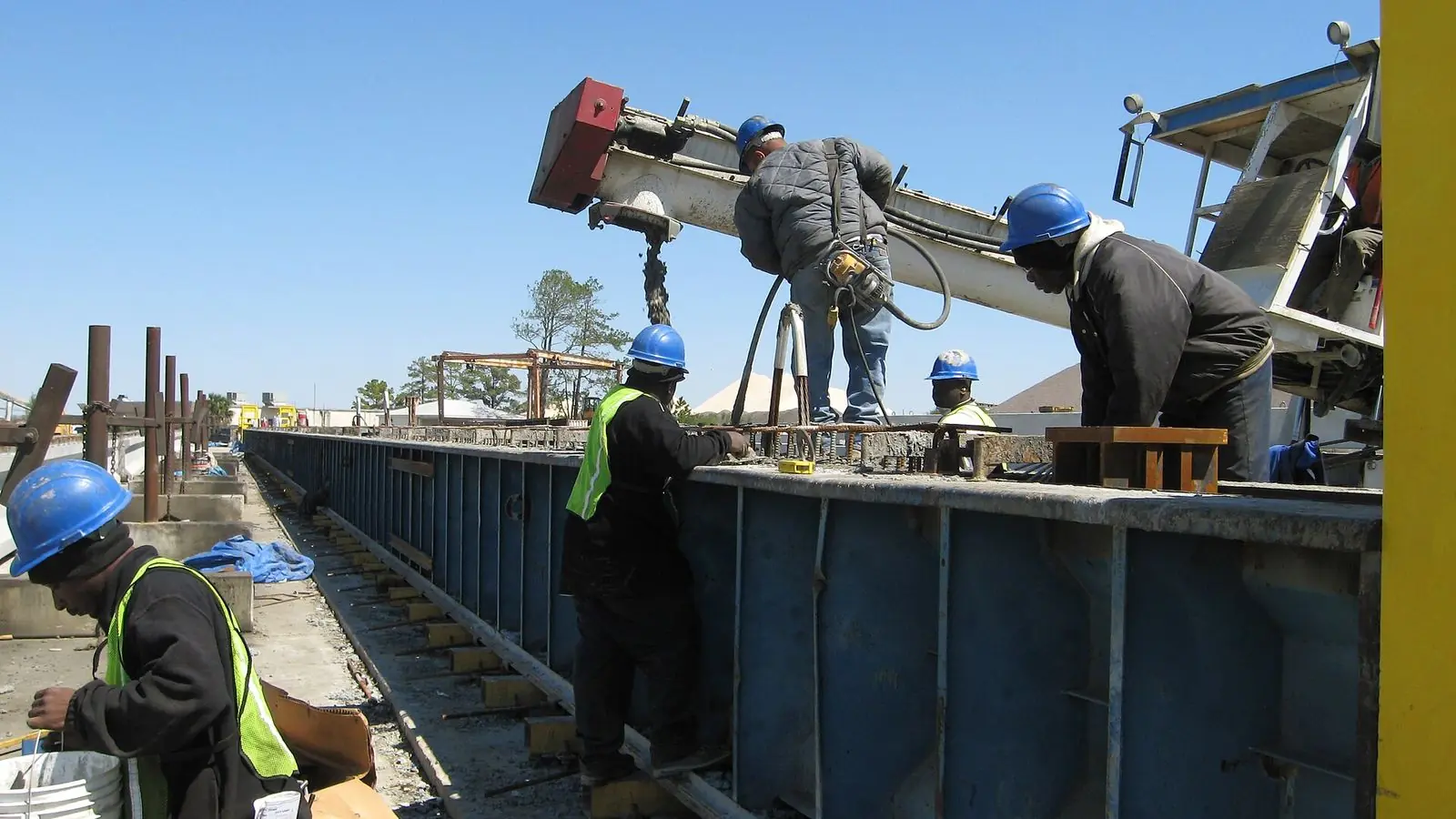
New workers carry the most risk while they learn, and they learn fastest next to someone who has done the job for years. When the experienced hand retires before the new one is trained, the gap lands on whoever is left on site. That is not a failing of either worker. It is what happens when know-how lives only in people's heads.
There is good news for the people in this picture too. Pay for construction production and nonsupervisory workers averaged $39.20 an hour in September 2026, 4.3 percent more than a year earlier, according to AGC's table of Bureau of Labor Statistics data,13 and an apprenticeship pays while it trains. For someone starting out, the shortage means a trade with steady demand and a visible path from helper to journeyman to foreman.
.jpg)
What this means for the business
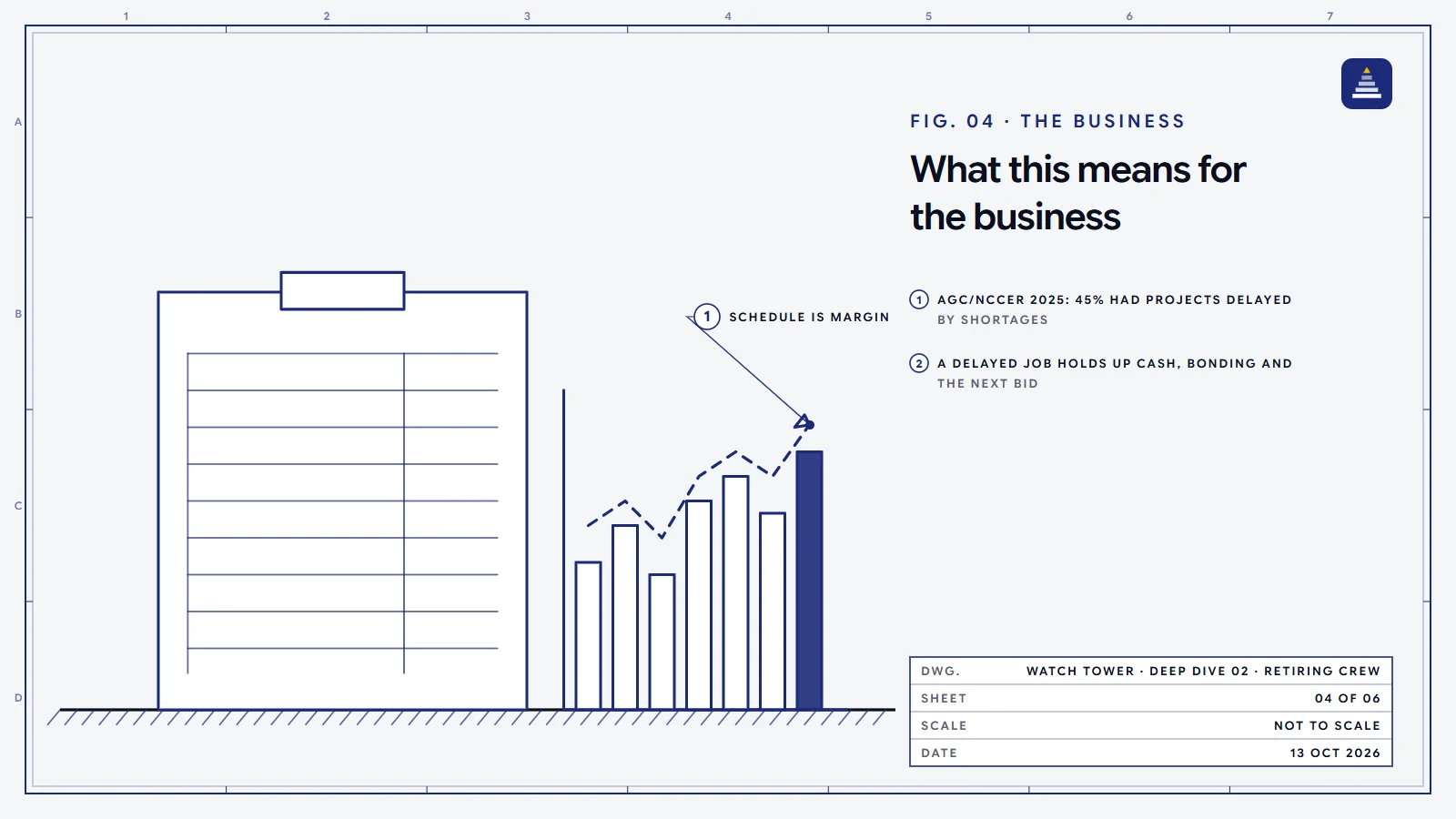
For a contractor, the worker gap shows up as risk in every bid. A schedule assumes a crew; if the crew is short, the job runs late, the next job starts late, and the payment that follows each milestone moves with it. 45 percent of firms in the AGC/NCCER survey had already had that happen.3
Hiring alone is not enough to cover it. With 92 percent of firms competing for the same workers,3 wages rise, and contractors who pay more still face the same months of training before a new hire works without supervision. The firms that do best tend to plan headcount against their backlog weeks ahead, and treat training as part of the job rather than something that happens on the side.
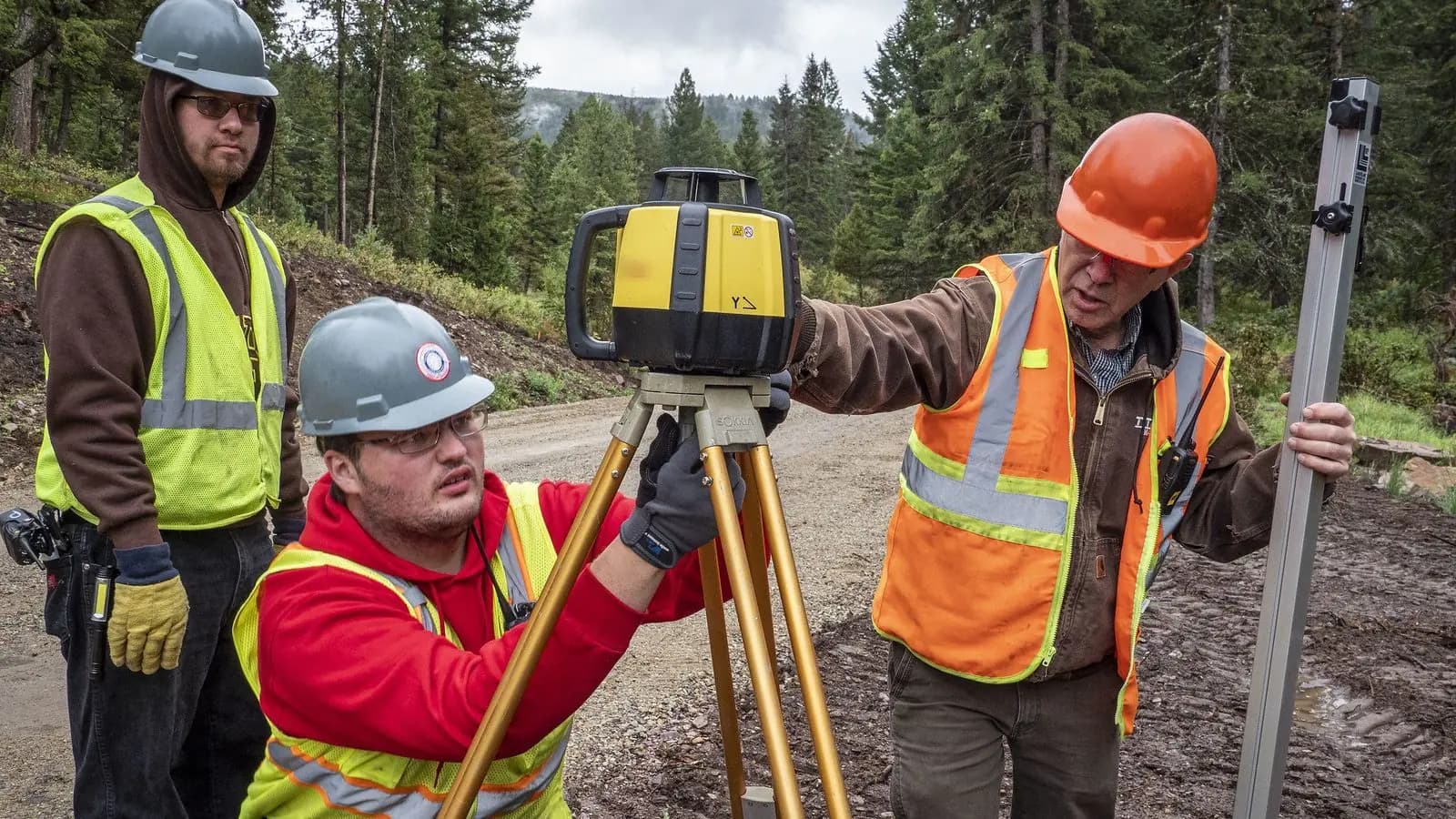
The business case and the people case meet in the same place. A contractor that keeps its senior crew's know-how on paper, and gets new hires productive and safe sooner, can take on more work with the people it has. A crew that has that support goes home with fewer close calls.

What keeps the know-how
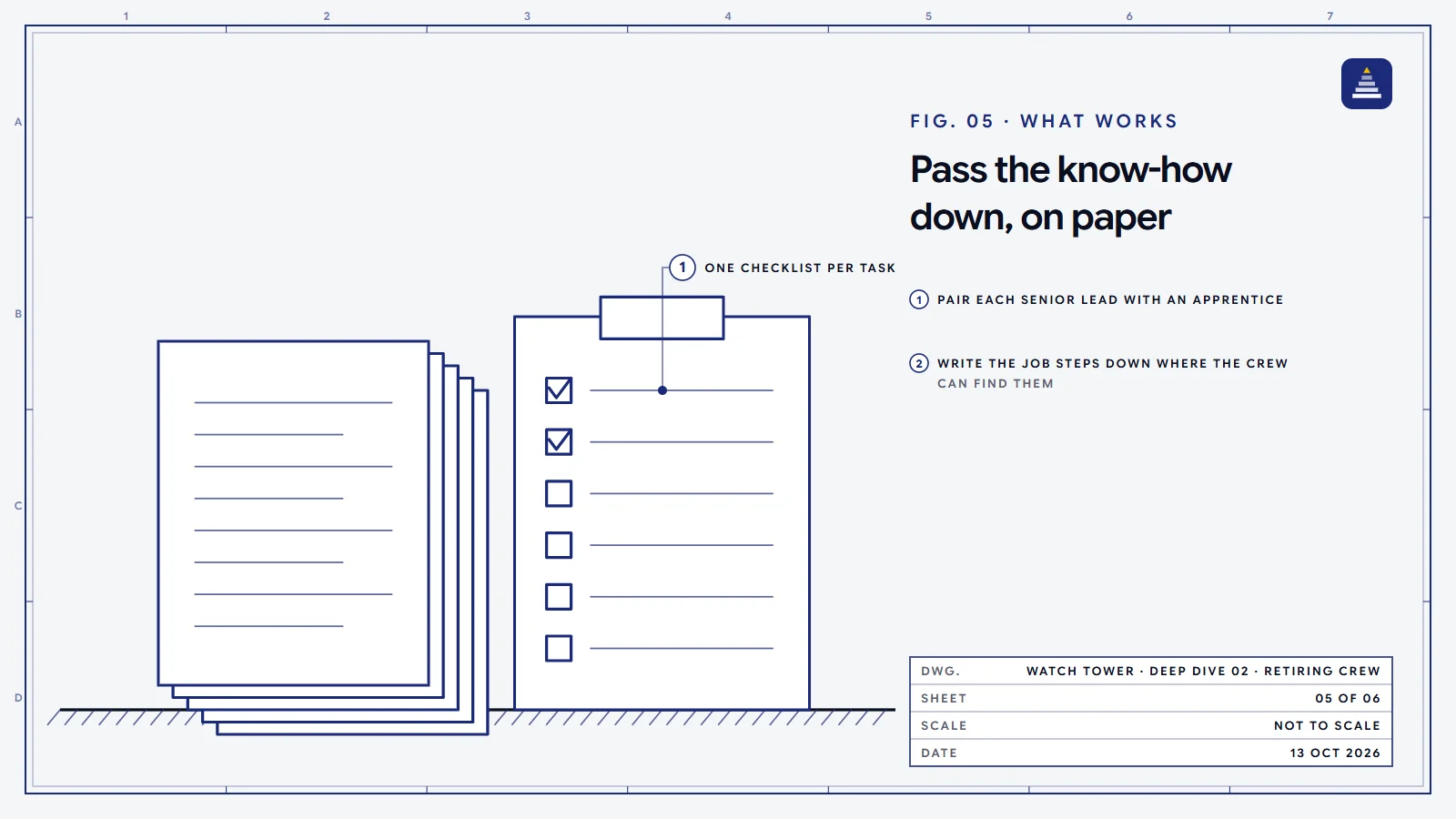
None of this needs a new kind of company. It needs a few habits that most contractors already know they should keep, and rarely have time for:
- Write it down while the expert is still here. Pick the ten tasks that only one or two people can do well. Have them walk through each one, step by step, and turn it into a one-page checklist with photos from your own jobs.
- Pair every new hire with a named mentor. Put the pairing on the schedule, not just in good intentions, so the senior person has time to teach.
- Plan the crew against the backlog. List the next 12 weeks of work by trade and compare it with who you have. A shortfall seen in week one can be hired for; one found on Monday morning cannot.
- Track who can do what. A simple skills list, by person and task, shows where you depend on a single person and who is ready for the next step up.
- Review it every month. Update the checklists after each job, and ask the crew what was missing. Know-how written once and never touched goes stale.
Where Applied Intelligence fits
At Norventus we call this Applied Intelligence: AI put to work inside a system, with a team behind it, until it pays off every day. For a contractor the goal comes first: keep the know-how of the people about to retire, and get new hires safe and productive sooner. The use is specific. It means turning a senior foreman's walkthrough into a clear checklist, organizing job photos and notes by task, and matching the next 12 weeks of work against the skills the crew actually has.
The system matters more than the tool. The records a contractor already keeps, such as daily reports, schedules, safety talks and photos, become the raw material. The people who know the work check every checklist before anyone relies on it. And the plan is reviewed every month, so it keeps pace with the crew. That last part is where most efforts fade, and it is the part worth designing for first.
The takeaway
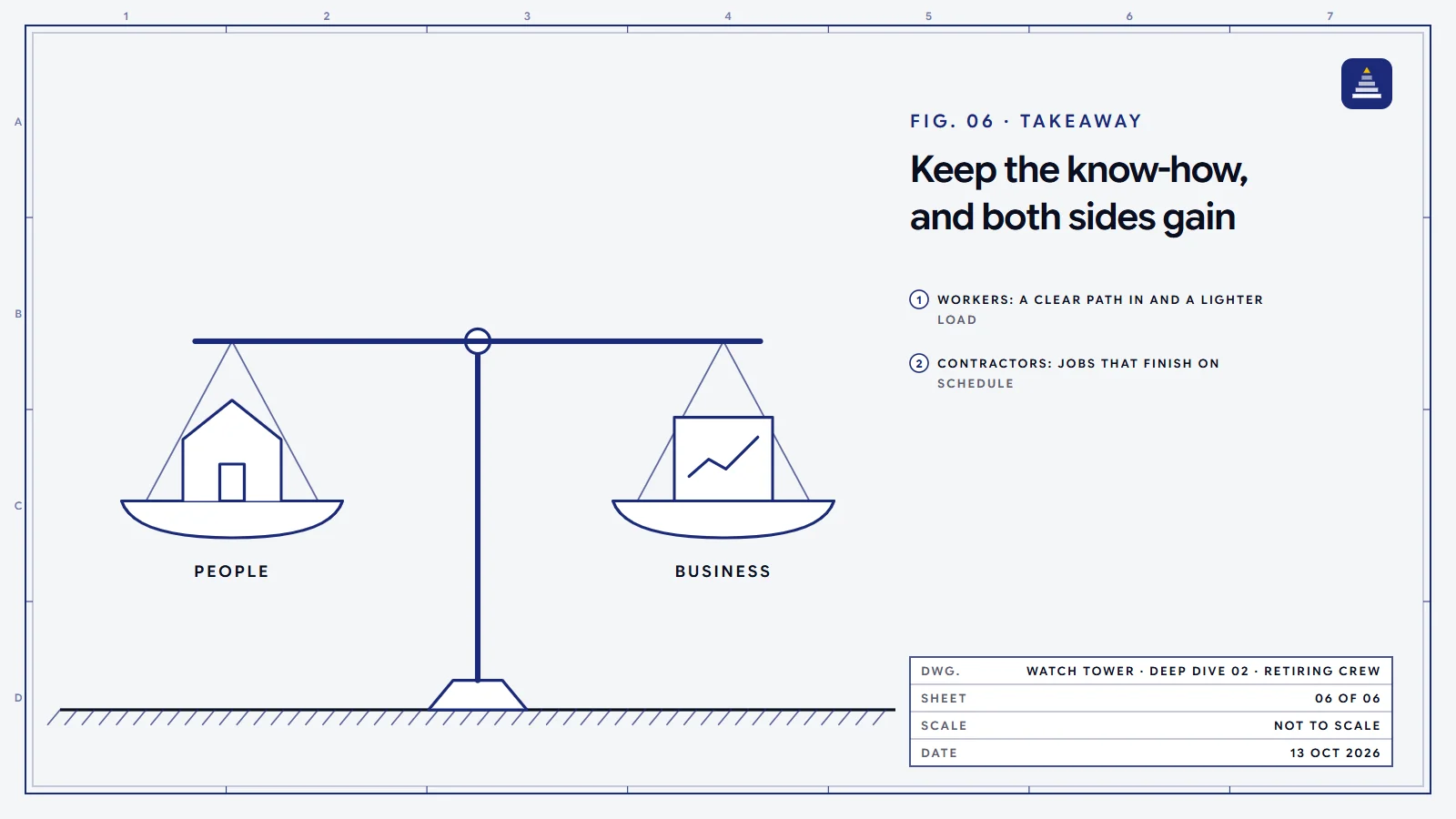
- Both sides gain from the same fix. When a crew's know-how is written down and taught, new workers start safer and move up faster, and the contractor can staff the work it bids.38
- U.S. construction must attract about 349,000 workers in 2026, mostly to replace retirees, and 456,000 in 2027.1
- 92 percent of firms struggle to hire, and 45 percent have had projects delayed by it.3
- Workers aged 55 and older were 22.3 percent of the construction workforce in 2021, up from 19.3 percent in 2015.6
- In a 30-person firm, on our stated assumptions, that is about one experienced person leaving every year, and the habit that matters is capturing what they know before they go.
Sources
- Associated Builders and Contractors, "Construction Industry Must Attract 349,000 Workers in 2026 Despite Macroeconomic Headwinds", January 15, 2026. www.abc.org/News-Media/News-Releases/abc-construction-industry-must-attract-349000-workers-in-2026-despite-macroeconomic-headwinds
- Associated Builders and Contractors, "Construction Industry Must Attract 439,000 Workers in 2025", January 2025. www.abc.org/News-Media/News-Releases/abc-construction-industry-must-attract-439000-workers-in-2025
- NCCER, "Report: 92 Percent of Construction Firms Struggling to Hire Workers" (2025 AGC/NCCER Workforce Survey), August 2025. www.nccer.org/newsroom/report-92-percent-of-construction-firms-struggling-to-hire-workers/
- Associated General Contractors of America, 2025 Workforce Survey: National Results. www.agc.org/sites/default/files/users/user21902/2025_Workforce_Survey_National_FINAL_m.pdf
- Contractor, "Construction Job Openings End 2025 at Nearly 300,000" (ABC analysis of BLS JOLTS data). www.contractormag.com/construction-data/news/55355827/construction-job-openings-end-2025-at-nearly-300000
- NAHB, Eye on Housing, "Age Distribution of the Construction Labor Force" (2015 and 2021 American Community Survey), June 2023. eyeonhousing.org/2023/06/age-distribution-of-the-construction-labor-force-2/
- NAHB, Eye on Housing, "Median Age of Construction Labor Force Holds at 42", October 2025. eyeonhousing.org/2025/10/median-age-of-construction-labor-force-holds-at-42/
- U.S. Bureau of Labor Statistics, National Census of Fatal Occupational Injuries in 2024, released February 19, 2026. www.bls.gov/news.release/archives/cfoi_02192026.pdf
- U.S. Bureau of Labor Statistics, Occupational Outlook Handbook: Construction Laborers and Helpers. www.bls.gov/ooh/construction-and-extraction/construction-laborers-and-helpers.htm
- U.S. Bureau of Labor Statistics, Occupational Outlook Handbook: Electricians. www.bls.gov/ooh/construction-and-extraction/electricians.htm
- U.S. Census Bureau, Monthly Construction Spending, December 2025 (annual totals for 2025), February 2026. www.census.gov/construction/c30/pdf/pr202512.pdf
- U.S. Department of Labor, Registered Apprenticeship Industry Fact Sheet: Construction, March 2026. www.apprenticeship.gov/sites/default/files/DOL_IndFactsheet_Construction-20260319.pdf
- Associated General Contractors of America, construction employment and average hourly earnings table (BLS data), September 2026. www.agc.org/sites/default/files/users/user21902/Employment-AHE%20table%20SEP%202026.pdf
- Construction Dive, "Construction's deaths and fatality rate in 2024" (construction industry figures from BLS CFOI), February 2026. www.constructiondive.com/news/constructions-deaths-fatality-rate-2024-hazards/812666/
Method: figures are copied from the sources above, by year as each source reports them. Where we calculate, the inputs and assumptions are shown next to the result. Charts are our own drawings of the cited data.