The Watch Tower Blog
AI Business Intelligence: From Dashboards to Decisions
AI business intelligence that people use every day, with answers that cite their sources and a system built around the decisions you make.

Most companies already have dashboards. Some have dozens. And yet the Monday meeting still ends with someone saying, "Let me pull the numbers and get back to you." AI business intelligence promises to close that gap, but only if it starts where the dashboard stopped: with the decision you actually need to make, and an answer you can check.
This post is about getting from charts to choices. Not more charts, and not a chatbot bolted onto the old reports, but a dependable system where AI, business intelligence and the people who run the business work together every day.
Why dashboards stall
Dashboards are good at showing what happened. They are much weaker at helping you decide what to do next. A typical dashboard answers questions somebody thought to ask when it was built. When a new question comes up, and in a real business new questions come up every week, it's back to exports, spreadsheets and the one analyst who knows where everything is.
There's a deeper problem too. Many dashboards show numbers without their origin. Which system did this figure come from? What period does it cover? Who owns it? Is it a firm count or an estimate? When nobody can answer those questions, people stop trusting the screen and go back to gut feel.
That is the first barrier, intent, in disguise. The business has data, and it has tools, but it hasn't connected either one to the decisions that matter. Adding AI on top of that doesn't fix it.
What AI business intelligence should actually do
Strip away the buzzwords and the job is simple. AI business intelligence should help a leader make a specific decision with better evidence, faster, and show its work.
That breaks down into a few practical abilities:
- Answer new questions in plain language, without waiting for a new report to be built.
- Cite its sources, so every answer comes with the records and periods it used.
- Flag weak evidence, so a guess is never dressed up as a fact.
- Stay tied to the decision, so the answer leads to an option, an owner and a next step.
That last point is where the second barrier, use, gets crossed. "Explore your data" isn't a use. "Decide which job types to stop bidding on" is.
Answers that cite their sources
Trust is the whole game in business intelligence. If a sales manager can't check an answer, she won't act on it, however clever it sounds.
In Watch Tower, our Applied Intelligence product for businesses, Bifrost is the insights assistant. It answers questions about your workspace and cites what it used. Ask why margin dropped on service contracts last quarter, and the answer arrives with the evidence behind it, so you can open the records and judge for yourself.
Underneath, Vulcan is the ontology: it holds the people, assets, processes and evidence of an organization as connected objects. That structure is what makes cited answers possible. An answer about a site can point to the assets on that site, the processes that ran there and the evidence recorded about them, rather than to an anonymous total in a spreadsheet.
An answer you can't check is an opinion. An answer that cites its sources is something you can act on.
The system around the intelligence
AI without a system is a demo. The intelligence only pays off if it lives inside a system people return to, and that system has to be designed around the decisions, not around the data warehouse.
Watch Tower's Console is that system: one place where leaders see the business, its evidence and its decisions. A few design choices make the difference between a screen people visit once and one they use every day:
- Start from the decision. The first thing a leader sees is the decision in front of them, not a wall of charts.
- Put evidence beside every number, with its source, period, owner and confidence.
- Show options, not just status. A good brief lays out two or three choices, each with its evidence and its guardrails.
- Record what was decided and why, so the next review starts from what the team already knows.
- Control who sees what. Nimbus handles governance and release: who can see what, why, and a record of every change.
What a decision brief looks like
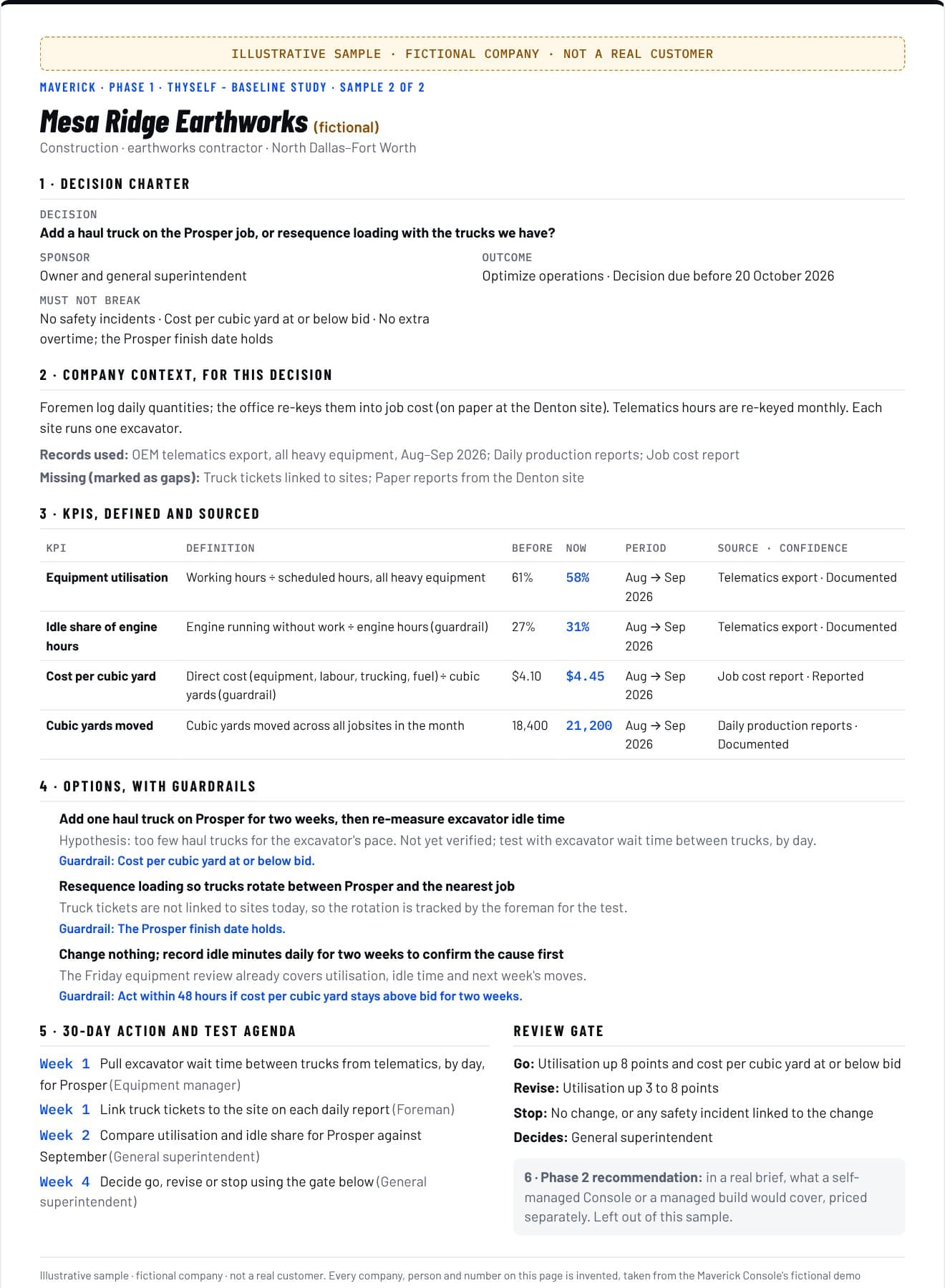
It's easier to show than describe. We built a sample decision brief to show what the output looks like. It uses fictional sample data, not a real customer, so you can judge the format before you bring us your own decision.
Picture a regional HVAC contractor using a brief like that. Instead of a dashboard of service calls by month, the owner sees one question at the top: should we expand maintenance contracts in the north service area next year? Below it sit the evidence, the gaps in that evidence, two or three options and what each would require. That is business intelligence that ends in a decision.

Crossing the capability barrier
The fourth barrier, capability, is where many business intelligence projects quietly fail. The tools are powerful but the team doesn't know how to use them, and nobody is around to ask.
The crossing is curation and teaching. Choose the few tools that fit the decision and set the rest aside. Teach them on real questions from your own business, in plain language. Build with the people who do the work, because the estimator, the dispatcher and the controller know which numbers are solid and which are rough. And stay reachable while habits form.
Watch Tower's Toolkits, shared with Forge, give analysts and desk teams practical tools with the assumptions behind every number shown, which is exactly the standard business intelligence should hold itself to.
Making it a habit
The fifth barrier is consistency: will this still be useful next week? Business intelligence that's opened only when the board asks has failed, however good it looks. It is a familiar pattern among AI implementation mistakes: a pilot that looks good in its first month and fades by spring.
Build the habit on purpose. Tie the Console to a meeting your team already holds. Review one decision each week with its evidence on screen. Follow up on the options you chose and record what happened. Over time, the system holds more of what the business knows, and each answer gets better grounded.
Your next step
Pick one recurring decision that your dashboards don't really help with. Write it as a question. List the evidence you'd want beside the answer.
Then read the sample decision brief to see the shape of the output, or see how this fits a wider rollout in our AI implementation plan for your company. If your numbers still sit mostly in spreadsheets, start with migrating your business to AI. When you're ready, bring us your decision.
Frequently asked questions
What is AI business intelligence?
AI business intelligence is the use of AI to help leaders make specific business decisions with evidence they can check. Instead of a fixed dashboard, people ask new questions in plain language and get answers that cite the records and periods behind them. The answer should lead to an option, an owner and a next step.
Will AI replace business intelligence dashboards?
No, AI is best used to pick up where dashboards stop. Dashboards still show what happened. AI business intelligence adds the ability to answer new questions without a new report, cite its sources and tie each answer to a decision, so the Monday meeting ends with a choice rather than a request for more numbers.
How can I trust answers from AI business intelligence?
You can trust an AI answer when it cites its sources: the records, period, owner and confidence behind each number. If you can open the evidence and check it, you can act on it. A good system also flags weak evidence, so a guess is never presented as a fact.
How do you get a team to use AI dashboards every week?
Tie the system to a meeting your team already holds and review one decision each week with its evidence on screen. Then follow up on the options you chose and record what happened. Business intelligence opened only when the board asks has failed, however good it looks.


_(52030164780).jpg)
.jpg)